
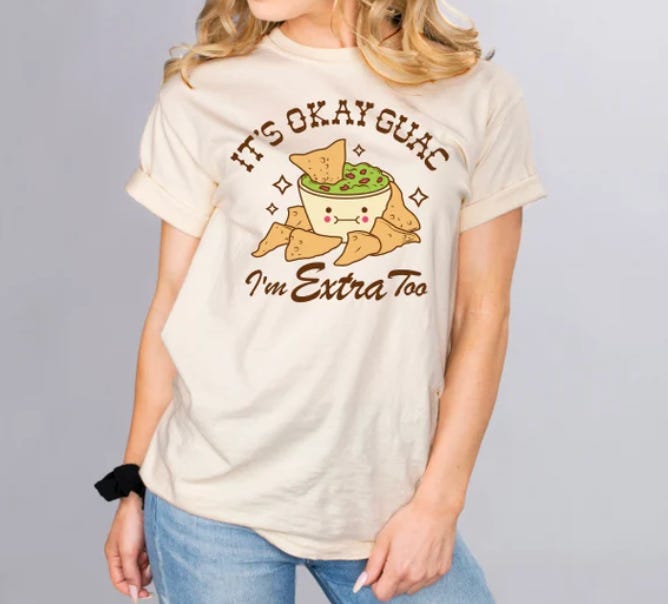
Our pricing problems started when we accepted that guac should be extra
rising prices is a game to how much the cusotmer will tolerate

Don’t feel like reading - here is the audio podcast link so you can listen on the go!
Once we collectively shrugged after being told guac is extra and handed over the $3 for 2 tablespoons of avocado (that probably cost them 25 cents), we opened a door that nobody has been able to close since.
Airlines started charging us to pick our own seats. It started as the ability to select your preferred spot, front, back, window, or aisle. And somehow evolved to them assigning families on the same booking seats in all corners of the plane then telling them if they want to sit together, they would need to pay extra.
Hotels check you in at 4 pm and kick you out at 11 am. That’s a five-hour gap where they’re charging the next person and no one’s in the room. Who decided that was normal?
Netflix started charging you extra to share the account you’re already paying for with a family member.
And BMW, this one makes me angriest, can remotely disable your heated seats if you don’t pay a monthly subscription fee. A physical feature in a car you 100% own can be shut off if you miss the extra payment.
Every single time, we said nothing. It was just a couple of bucks. We moved on with our busy day.
These past few years have been a test - they wanted to see how far they could push consumers.
How much would we continue to pay?
The answer… a lot.
-
Now we’re at a tipping point, and it’s most obvious in the luxury market
The $3 side of guac? It’s now $7 in some restaurants. That’s over a 100% increase. But hey, it’s only $4, might as well pay it and move on…
That 100% is magnified when you are dealing with luxury products - and yea, the consumer is finally starting to notice.
My favorite example is the Chanel Classic Flap bag.
In the 1980s, it cost $1,000. By 2019, it was $5,800. By 2025, it hit $11,300.
That’s a near doubling in six years. For the same bag.
And here’s the part brands are praying you are not paying attention to: while prices were going up, quality was quietly going down.
A Dior subsidiary was found paying €53 to manufacture a bag that retails for over €2,000. In the past few years, Italian prosecutors placed Dior, Armani, Valentino, and Loro Piana under court administration for labor exploitation in their supply chains.
The price went up. The bag got cheaper to make. And we kept buying.
Until we didn’t.
GUCCI’s recent moves show an industry in crisis
For the first time ever, Gucci has paused price increases. Publicly committed to focusing on a creative reset under the new designer, Demna Gvasalia.Whatever that means.
Luxury sales dropped across the board in 2024, and LVMH profits fell 22% in the first half of 2025.
The fashion world has hit a tipping point. Actually, the world has hit a tipping point.
People are tired of paying more for less. And they’re finally saying so with their wallets.
Do this one thing to compete where luxury brands won’t
So here’s where it gets interesting for you.
Because while the big brands are scrambling to figure out why nobody wants to buy their overpriced, underfunded products anymore, there is a massive gap in the market for brands that do the opposite.
Give more. Charge less. Surprise people instead of nickel-and-diming them.
It’s easier than it sounds, and it won’t cost you nearly as much as you think it will.
Next week, I’m going to show you exactly how to do that, $30 worth of value to your customer that will cost you under $1.
In a world where everything feels expensive, and every company feels like it’s trying to squeeze you, being the brand that gives something extra isn’t just a nice thing to do, it’s a competitive advantage.
See you next week,
-Melanie
PS - In case you are curious…
Our time in Bangkok is sadly coming to an end. But we aren’t quite sure where we are heading next.
Will has work to do in the Maldives (I know poor us), so we are either going to go there first and then head back to Goa, or maybe go back to Goa, pack up the house, head to the Maldives, and then back to the States for the summer.
We will see.
We have really enjoyed our time in Bangkok and are thinking about making it a more regular part of our lives.
As an ex-New Yorker, it kind of feels like Manhattan, but with rose colored glasses.
It’s convenient, many neighborhoods are walkable, it’s extremely safe, and things are affordable - meaning it’s not bougie to get a massage and facial every week - it’s just the norm. There is amazing food, both Thai and international (honestly, better than most of the overpriced slop in trendy Manhattan joints these days), and fantastic doctors. And the city feels calm, not fueled by rage.
We haven’t really found many or any negatives, to be honest.
While we like our time in the jungles of India, we have been missing city life for the past few years, and a couple of months each year in Bangkok might just solve that.
Any other Americans thinking about making a move? In my mentorship groups, there are a few people, but it’s hard to find the right location that is worth uprooting your entire life for, especially once the honeymoon phase of a new place wears off (IYKYK).
Lastly, before I go, a few cool things…
A little bit about my personal life - what I’ve been up to these past 8 months that isn’t fashion related.
The difference between rayon, vicose, modal, tencel, and bamaboo - the last one might shock you.
Did this female founder just rip me off?
The chainsaw we use to cut fabric at the factory.
Apparel factory lingo that you need to know before you talk to a factory.